


The Rome Apprenticeship con Charles Weed: siamo molto felici si annunciare che Charles Weed ritornerà a Roma nel 2018 per condurre una nuova tipologia di workshop continuo di pittura ad olio. Per quattro giorni ogni due mesi, Charles lavorerà con gli studenti che aspirano a sviluppare ulteriormente le tecniche della pittura diretta e costruire un quadro nel tempo.
Per qualsiasi pittore interessato ad arricchire la propria formazione nella pittura ad olio, questa è un’occasione da non perdere!
Per tutti i dettagli, visita la pagina The Rome Apprenticeship with Charles Weed.


La nuova stagione di corsi di pittura ad olio e disegno riprende il 14 settembre 2017.
Lo spazio è, come sempre, limitato!
Per dettagli e registrazioni, visitate la pagina dedicata ai corsi.


Il corso di Disegno del Nudo comincia giovedì 4 febbraio; il corso Dipingere il Ritratto alla Prima ed il corso di Pittura Avanzata cominciano il 6 febbraio 2016. Iscriviti oggi! In più, ho il piacere di invitarti ad una ‘lecture’ aperta al pubblico sabato 6 febbraio alle 15:00. Per tutti i dettagli, visita la pagina dedicata ai Corsi.

La prima esposizione di quadri degli studenti di PADASOR dal 2010 si terrà domenica, 13 dicembre 2015, dalle 18:00 alle 21:00 presso lo Studio Soderini in Via Fulcieri Paulucci de Calboli, 20E in zona Prati.

Max Doerner said “it is no more possible to learn to paint from books than to learn to swim on a sofa.” A variation on that could easily be “it is no more possible to learn to draw from photographs than to learn to swim on a sofa.”
That said, I’ve realized in recent years that it can be very helpful to compare a life drawing to a photograph, especially given the ease with which it can be done. Here’s what you need to do it:
Step 1. Take a picture of your drawing, then take a picture of your model, taking care not to get too close in order to avoid an overly distorted image.
Step 2. Import both pictures into the image editor, placing one on top of the other. If they are different sizes, don’t worry.

Here I have imported the photo of the model, Flavia.
Step 3. Scale the photo of the model to the drawing (Don’t worry if the model image gets pixelated.) To do this, put the model image on top of the drawing image, set the model image to 50% transparency and increase (or decrease) the size of the image until it more or less coincides with one or more of the principle features; I usually target the eyes and nose.

With the image of Flavia at 50% transparency, I’ve matched the size of her image to the drawing below.
Step 4. Bring the model image back to 100% transparency and trace paths over the principle lines of the features: the contours of the head, the ears, the shadow around the eyes, the nose, mouth, chin, etc.

Here you can see the I’ve traced her features using a mouse and the pen tool in Fireworks.
Step 5. Turn off the model image and—voilà—you’ll immediately see right away what is right and what isn’t.
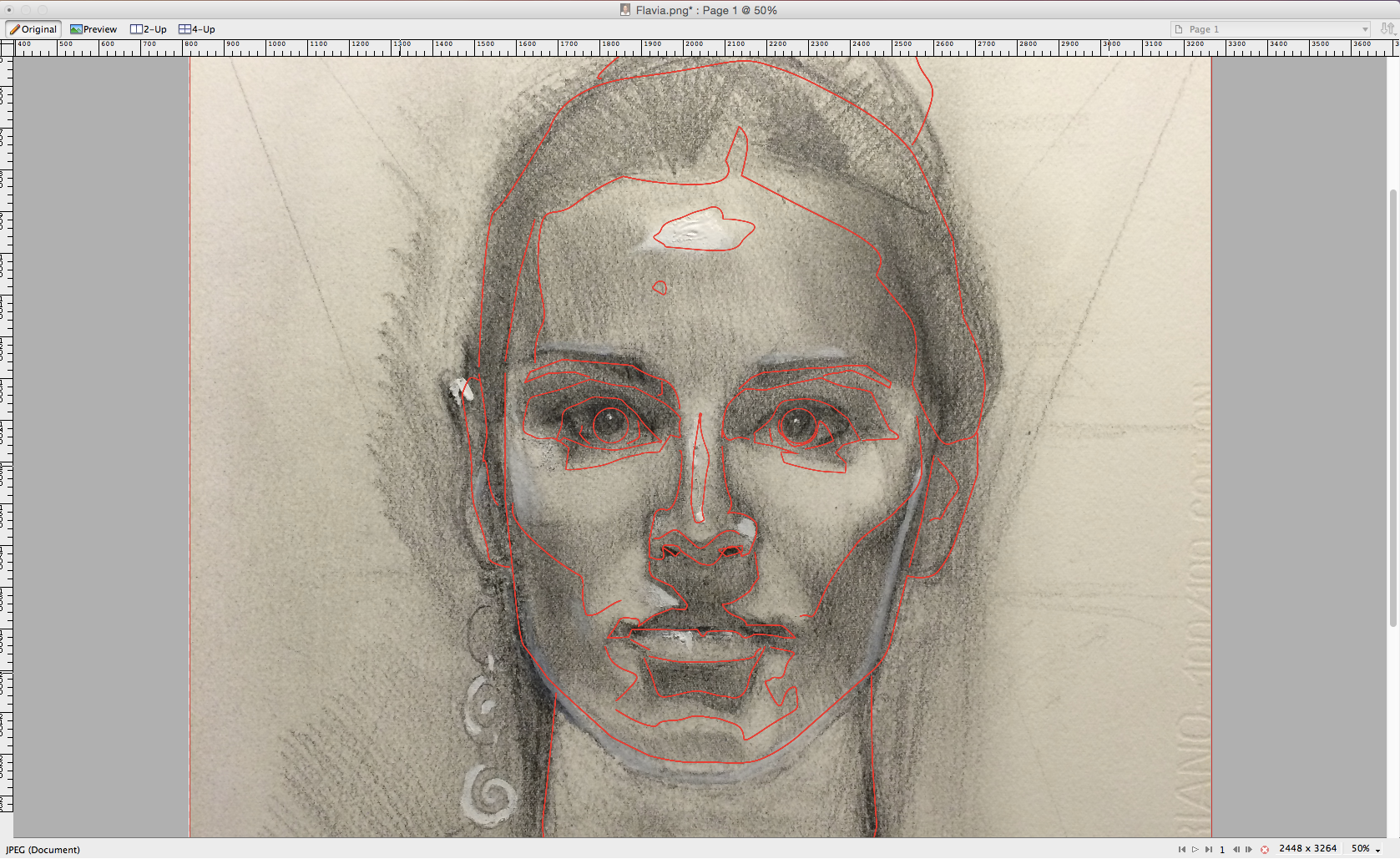
I centered the drawing on the nose, so that works. But the eyes are little too high (making the face seem longer) and her jaw on the right needs to be wider. It’s amazing how these small errors can make a big difference!
One of my students, Stefano, also did a similar analysis, I believe with photoshop:
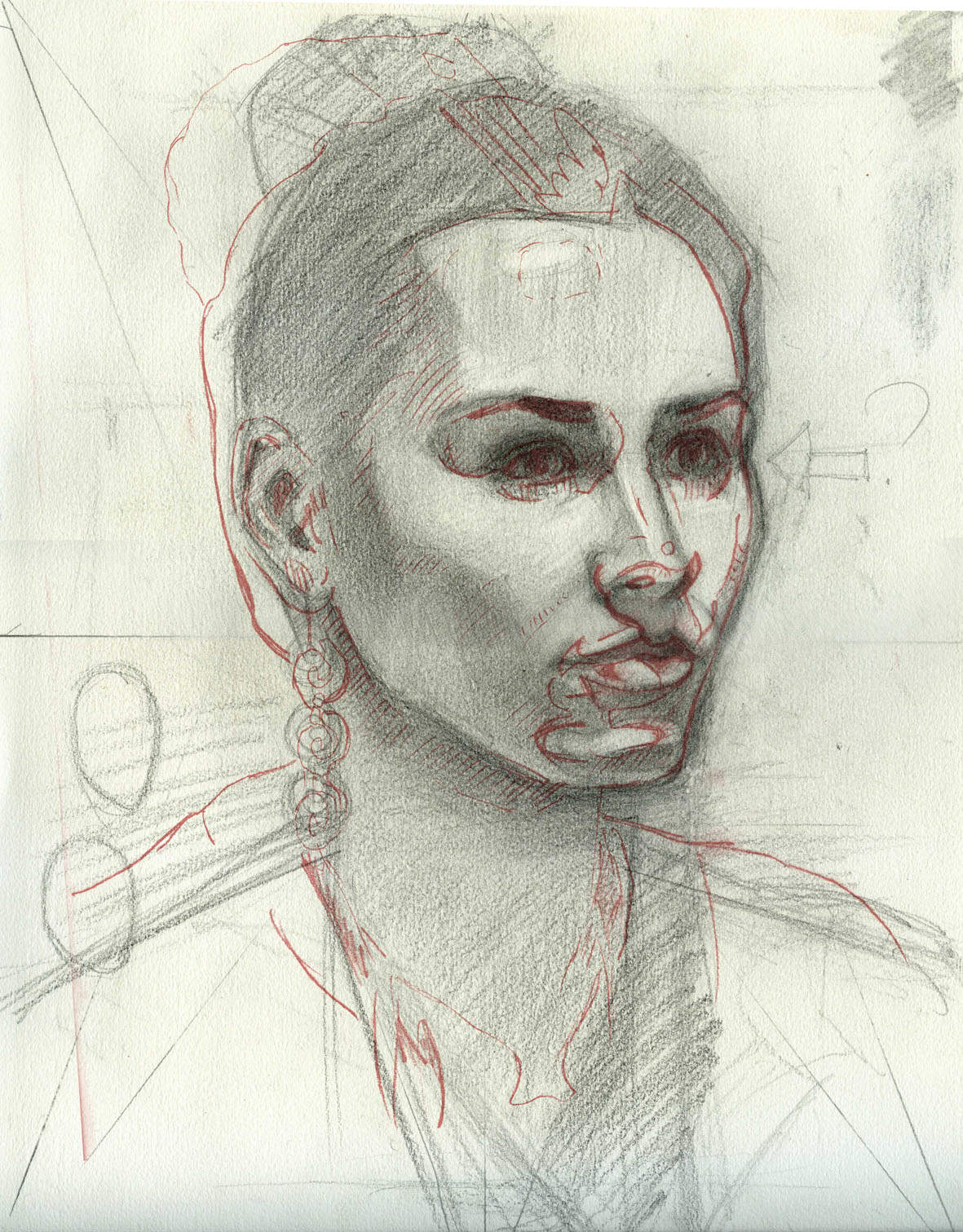
The eyes are very close, but note how dramatic the change is with the corrected line of the shoulders and the addition to the left side of the head.
Bravo, Stefano!
Conclusion: avoid trying to improve you drawing by working from photographs, but take advantage of technology to help you calibrate your hand/eye coordination. You’ll strengthen your sense of proportional relationships and start to realize things like a short jaw doesn’t mean make it longer, rather the mouth and nose are too low. You’ll also become aware of where you have a tendency to err: I knew before starting the drawing that I tended to make noses too long—and during the drawing I moved it up twice!—but that still wasn’t enough. Now it should be relatively easy to make some fixes… then I’m ready to transfer the drawing and start painting.
 News from TJA
