


Secrets of the Bottega: What You Can Learn

We specialize in teaching students and traditional oil painting enthusiasts about the following topics:
- Understanding different types of canvas and learning how to stretch them by hand
- Sizing canvas: how to use rabbit-skin glue, why it is necessary, and understanding the contemporary alternatives
- Gluing canvas to wood panels
- Learning the difference between traditional oil, water-based and acrylic gessos, how to make and apply them to the canvas, understanding what it means to use a colored ground or imprimatura
- Drawing on a gessoed surface and fixing (sealing) the drawing
- Examining the nature of pigments and how different colors can be achieved with same pigment
- Mixing pigments into paste, then mulling them by hand into pigment and putting them into tubes
- Learning about solvents, oils and resins and modern equivalents
- Examining how various mixes of natural oils and essential oils can be combined for different mediums
- Exploring the difference between direct and indirect painting techniques, including an understanding of glazes and scumbles
- Focusing on Caravaggio’s palette in the service of skin tones and the means by which he developed highly refined volumes with light and shadow
Caravaggio’s Palette:
Pigments and Alchemy
 On May 29th, 1606 there was a dramatic turn of events in the life of Caravaggio: in what is mostly believed to be a dispute over a gambling debt, he killed a man name Ranuccio Tomassoni. As a result, Caravaggio was forced to flee Rome, leading a peripatetic life over the next several years that took him from Naples, to Malta, to Sicily and back to Naples. In 1610 he was negotiating for a pardon from the new Pope, Paul V, with the hope that he could return to Rome; on a journey from Naples to Porto Ercole he died under mysterious circumstances. (For more on his life’s history, visit Wikipedia.)
The point of this history lesson is simple: I find it highly unlikely that Caravaggio was able to easily travel with any significant amount or range of pigments, meaning he continually had to make use of local materials. The good news for Caravaggio is that many of the colors in his palette were popular and available: calcium carbonate (marble dust, crushed shells), lead white (basic lead carbonate), charcoal black (charred sticks or bones), and earth colors from the local landscape.
Furthermore, with a small cooking fire he could easily transform yellow or light brown pigments into red or dark brown. In the picture above, you can see an example of what happens to a yellow Raw Sienna when heated in pot for only a few minutes.
One of the things we actively explore in the Bottega is the transformation pigments and, of special note, what happens when these pigments are heated with other materials, like calcium carbonate (see the image below).

The Key to Caravaggio Flesh Tones
Many painters from the Baroque famous for their handling of flesh–Rubens, Rembrandt, and Van Dyck come to mind–often display a temperature range that is sometimes referred to as ‘silver and gold’, meaning the highlight is cool, the light is warm, the halftone is cool (grey) and the shadow is warm.
By contrast, and primarily after 1600 (starting with his paintings of St. Matthew in the Contarelli chapel), Caravaggio tends to keep the overall skin tones warm.
It took me some time to understand what the base colors were that made up these flesh tones, but after a study of Judith and Holofernes in Palazzo Barberini in 2024, I was able to understand the importance of Lead-Tin Yellow Type II (photo below). Unlike Lead-Tin Yellow Type I, a color I was already familiar with, Type II is inherently much darker in value, which, when mixed with lead white, enables a base flesh that is closer to the values needed to keep them a) darker than white, b) warm, and c) luminous as a result of its chroma.
Use of this color (and modern colors that can substitute it) are a principle part of the study of Caravaggio’s palette.

Join Us for a Workshop, a Course, or Book a Private Experience
Photo below: Raul and Tim conduct a free workshop during a PADASOR Open Day.

Free Workshops
Tim and Raul often offer free presentations during a PADASOR Open Day at the start of each semester, typically at the start of February and September. The best way to be notified of these events is to sign up to our mailing list.
Weekly Group Courses
Tim’s course specializing in Caravaggio’s painting techniqe is called In the Skin of Caravaggio. It runs at least once a year, normally during the Spring semester.
To learn more about our current courses, visit our Course Registration Portal.

Book a Private Group Demonstration
The cost of a private demonstration is €250 for 2 people and lasts just over an hour. (€50 for each additional participant.) During the demonstration we will show you how to:
- Transform the color of pigments
- Mull paint into a pigment and tube it for conservation
- Use the hand made paint with others to illustrate Caravaggio’s palette and how he used it pain flesh tones
Book Your Private Lessons
Private lessons are for those who would like at least a series of 6 lessons of 2. 5 hours each. By the end of the 6 lessons we will have:
- Stretched and prepared a canvas with rabbit skin glue
- Prepared the canvas with a dark ground
- Analyzed Caravaggio’s compositions and technique
- Learned how to hand grind pigment into paint
- Worked from the model using Caravaggio’s palette
The base cost for the six lessons/15 hours is €1,050 + model fees and materials.
What Makes a Caravaggio a Caravaggio? Beyond Technique
For me, great painting is not about the ‘What’ or the ‘Why’. It is the ‘How’.
How was it conceived? How was it drawn and composed? How was it painted? And if a narrative, how did the artist choose to visually freeze that moment in time?
The later question is one of the easiest to overlook when examining Caravaggio. Why? Because the imagery seems self-explanatory. They are images made with ‘feet on the street’, literally and metaphorically: we look down at pilgrims with dirty feet; we look look down at a sprawled soldier fallen from a horse; we look down at an old man about to be tipped upside down on a cross. What is there to explain?
There is so much to explain. So much to analyze. So much that we take for granted because we come to these images with a lazy assumption that his perspective is obvious: could we not do the same thing with the phone in our pocket in an instant?
Yes. And that is where the deception begins, even in his own time. I believe Caravaggio exploited his power of naturalism and realism to hide his true intentions. The position of hand, the scale and proportion of a figure, the perspective of the viewer to the martyr were all visual tools he used as a bait and switch. The true story is revealed through formal analysis.
An understanding of formal analysis is also a part of the teachings in the Bottega.
What is a ‘Bottega’?
In the 16th and 17th century, the bottega was the artist’s studio where he would work with his assistants and train them to stretch and prepare canvases, make pigments, and paint specific sections of large paintings, while also giving them the opportunity to practice their own drawing and painting. A famous etching (below), entiteld The Painter’s Studio, made by Philip Galle in 1595, details many of these activities.

Meet the Bottega’s Colourman: Raul Portella
In the 17th century, a colourman was a merchant or artisan who prepares and sells paints, pigments, and artists’ supplies.
My professional experience as a coulourman, developed over more than twenty-six years of genuine passion for the fine arts, has its roots in the historic Ditta Poggi, a prestigious institution with more than two centuries of artisanal tradition. In this environment of excellence, I have acquired an in-depth knowledge of art materials, painting techniques, and conservation methods, developing a level of expertise that today allows me to work as a specialized technical consultant and a point of reference for professional artists and enthusiasts alike.
My work begins with the very birth of the artwork itself. I create custom-made frames and prepare canvases according to the highest quality standards, adapting each support to the specific needs of the artist.
My research also extends into the world of color, where I transform pure pigments into expressive tools for the most diverse techniques — from egg tempera to oil painting, from watercolor to pastel, and even to contemporary acrylic formulations. At the same time, I produce handmade mediums, varnishes, and customized preparations, the result of a balance between tradition, scientific knowledge, and experimentation.
The two-hundred-year legacy I have inherited, together with my ongoing technical research, allows me to support artists at every stage of the creative process, contributing to the durability, quality, and full expression of the artist’s work.
Raul Portella
June, 2026
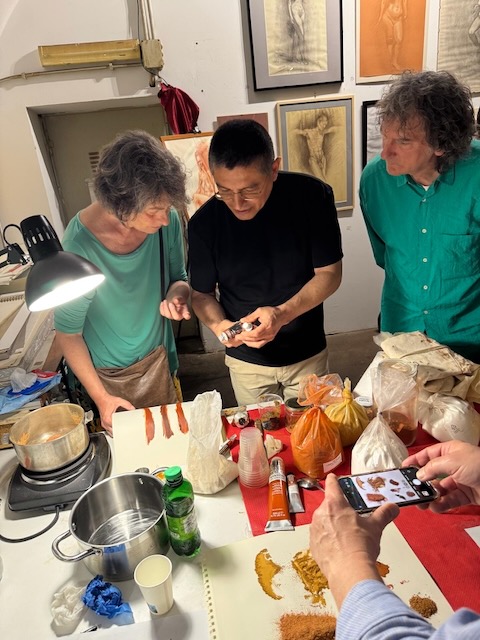
Photos above: Raul Portella shares his knowledge during a PADASOR Open Day presentation.


A History of Studying Caravaggio
I do not have a memory of seeing Caravaggio for the first time. Like many great painters, it feels like they have always been there.
I do remember the amazement and sadness I felt when seeing The Death of the Virgin in the Louvre and learning the painting had been rejected by the patrons and, as a consquence, was not hanging in a church in Trastevere.
I do remember the awe I felt looking at the massive Beheading of John the Baptist in Malta and thinking, finally! someone knows how to light a large painting, even though it never would have enjoyed such illumination in his time… which then begs the question, how would he have lit the painting?
And I remember with great clarity standing in front of The Calling of Saint Matthew and investigating with the late great Prof. Terry Kirk the identity of Matthew. (See the link to The Calling of Someone at the Table for more details.)
Rome is home to the largest collecction of Caravaggio paintings, many of which are located where they were meant to hang, a factor that readily enriches a greater understanding of context and a deep dive into formal analysis; for those wanting to study the work of Caravaggio in depth, there is no better place to be than Rome.
I had moved to Rome indefinitly in 1998, it wasn’t until the mid 2000’s when I became keenly interested in better understanding the technical aspects of his painting process (and those of many others), in no small part due to the extraordinary access to resources that became possible through the internet.
One of the critical moments in particular was access to the technical bulletins produced by the National Gallery of Art in London.
Then, in the 2010’s I discovered a book dedicated to Caravaggio’s technique that was fruit of a conference recently held, which in turn led me to some face-to-face discussions with Claudio Seccaroni, Claudio Falcucci and Daniela Storte.
The turning point came in 2016 when I wandered into the book shop at Palazzo Balducci and stumbled upon two volumes dedicated to an analysis of all paintings by Caravaggio in Rome.
In it were many glorious analyses of the materials used and speculation on how Caravaggio may have gone about making them… but did anyone actually ever try it?
I reached out to one of the authors, Dott.ssa Beatrice De Ruggieri, I believe some time in 2020 and asked her that very question.
She was kind enough to reply… and from that moment a wonderful collaboration and friendship was set in motion. It is thanks to her that we had the extraordinary opportunity to work in front of Caravaggio’s Judith and Holofernes in Palazzo Barberini in 2024 (for an article on that experience, see the link below).
After that experience, I developed the course In the Skin of Caravaggio.
Other collaborations with the Dott.ssa have included a portrait painting course dedicated to her translation from English to Italian of what is known as the Symonds manuscript, a detailed account of the Englishman’s time Roman studio of Giovanni Angelo Canini in 1650.
Tim’s Writings on Caravaggio
- 2024, June – DECODING CARAVAGGIO: Bridging the gap between technical analysis, theory and performance
- 2024, May – Investigating Caravaggio: What Can Technical Analysis Tell us about Technique?
- 2018, August – From the Graveyard: Formulas for Flesh – Part I: Caravaggio, Guercino, Reni and Caracci
- 2014, April – Seeing is Believing: Caravaggio’s Conversion of Saul, Formal Analysis and Critical Thinking
- 2010, July – The Calling of Someone at the Table: A painter’s analysis of Caravaggio’s Calling of Saint Matthew.

Above: a comparison of the original (left) and Tim’s copy (right), including x-rays

Above: Tim in the Louvre in the mid-2000’s in front of
The Death of the Virgin
Below: Tim in Malta in 2012 in front of
The Decapitation of John the Baptist


Above: Tim and the Dott.ssa Beatrice De Ruggieri in April 2024
at the start of their investigation in Palazzo Barberini in front of
Judith and Holofernes
Below: Dott. Marco Cardinali, Tim and Dott.ssa Beatrice De Ruggieri
in May 2024 at the end of their investigation.
The two copies can be seen on the left.

 News from TJA
- Pharos August 14, 2026
- Castro: L’Argentiera at Sunset July 19, 2026
- Ginevra June 21, 2026
- Circe June 20, 2026
- Self-Portrait as Rembrandt in the PADASOR Studio December 5, 2025

